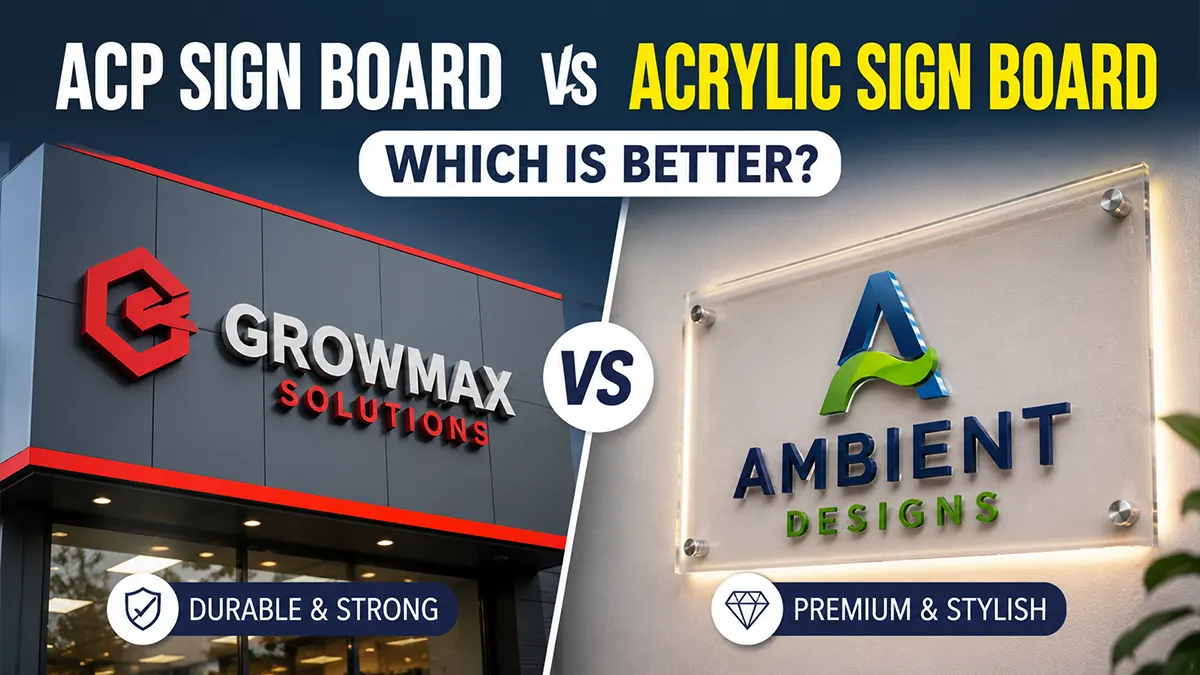
Choosing the right material for a business sign board can affect appearance, durability, maintenance, customization, lighting, and the overall cost of a signage project.
ACP and acrylic are two commonly considered materials for commercial signage. Both can create professional-looking signs, but they have different characteristics and are better suited to different applications.
ACP, or Aluminium Composite Panel, is often used as a structured sign surface and can be suitable for many exterior applications. Acrylic is a versatile plastic material that is frequently used for sign faces, raised lettering, decorative signage, and illuminated designs.
So, which one is better: an ACP sign board or an acrylic sign board? There is no single answer for every business. The right choice depends on the location, design, size, lighting requirements, environmental exposure, maintenance expectations, and budget.
ACP vs Acrylic Sign Board: Quick Comparison
| Factor | ACP Sign Board | Acrylic Sign Board |
|---|---|---|
| Material | Aluminium composite panel | Acrylic plastic sheet |
| Appearance | Clean, flat and modern | Smooth, polished and versatile |
| Large Panels | Generally well suited | Depends on design and application |
| Raised Letters | Can be combined with letters | Well suited |
| Illumination | Can be incorporated into signage | Particularly useful for illuminated lettering and faces |
| Maintenance | Generally straightforward | Requires care to avoid scratches |
| Common Application | Exterior panels and storefronts | Letters, sign faces and premium decorative signage |
What Is an ACP Sign Board?
ACP stands for Aluminium Composite Panel. It is a composite panel material commonly used in architectural, commercial, and signage applications.
An ACP sign board generally uses an aluminium composite panel as the main background or structural surface. The business name, logo, graphics, lettering, or other branding elements can then be applied or mounted onto the panel.
ACP is available in different colours and finishes, allowing businesses to create signage that fits their brand identity and storefront design.
Common Uses of ACP Sign Boards
- Shop and showroom sign boards
- Office exterior signage
- Commercial building branding
- Retail storefronts
- Corporate signage
- Exterior branding panels
What Is an Acrylic Sign Board?
Acrylic is a plastic material available in transparent, translucent, opaque, and coloured forms. It can be cut, shaped, printed, engraved, or fabricated into different signage components.
Acrylic is often selected when businesses want a smooth and polished visual appearance. It can be used as a sign face, lettering, logo element, or decorative component.
Acrylic is also commonly considered for illuminated signage because translucent acrylic can allow light to pass through selected areas of a design.
Common Uses of Acrylic Signage
- Retail shop signage
- Reception signs
- Corporate office signs
- 3D lettering
- Illuminated signs
- Interior branding
Appearance and Design: ACP vs Acrylic
Appearance is an important consideration because a sign board is often one of the first visual elements customers notice about a business.
ACP generally creates a flat, structured, and contemporary background. It can work particularly well when the design uses a large panel with lettering, logos, graphics, or dimensional elements.
Acrylic can provide a smoother and more polished appearance. It is available in various finishes and can be used to create dimensional lettering, coloured elements, transparent designs, and illuminated effects.
ACP Appearance
- Clean and modern
- Suitable for larger backgrounds
- Works well with graphics
- Available in different finishes
Acrylic Appearance
- Smooth and polished
- Suitable for dimensional letters
- Available in different colours
- Useful for illuminated designs
Durability and Weather Resistance
Durability depends on more than the material name. Thickness, product quality, fabrication, mounting, environmental exposure, and maintenance can all affect the service life of a sign.
ACP is commonly considered for exterior signage because it provides a rigid panel surface and can be fabricated into different sign structures.
Acrylic can also be suitable for exterior applications when the appropriate product, thickness, fabrication method, and installation are selected.
| Consideration | ACP | Acrylic |
|---|---|---|
| Sun Exposure | Depends on panel finish and graphics | Depends on acrylic grade, finish and graphics |
| Rain and Moisture | Suitable for many exterior applications when correctly installed | Can be used outdoors with suitable specification |
| Physical Impact | Panel construction provides structural rigidity | Performance depends on thickness and application |
Maintenance: Which Is Easier?
Both types of signage can be relatively easy to maintain when properly fabricated and installed. However, cleaning methods should match the material and finish.
ACP surfaces can generally be cleaned using appropriate non-abrasive methods. Acrylic should be handled carefully because unsuitable cleaning materials or rough handling can scratch the surface.
ACP Maintenance Tips
- Remove dust regularly
- Use suitable cleaning products
- Avoid harsh abrasive materials
- Inspect mounting periodically
Acrylic Maintenance Tips
- Use soft cleaning materials
- Avoid abrasive cleaners
- Handle surfaces carefully
- Check illuminated components when applicable
Customization and Lighting Options
Businesses may want their signage to match an existing logo, colour palette, storefront design, or interior branding. Both ACP and acrylic can support different customization approaches.
ACP Customization
ACP can be used as a background panel with vinyl graphics, printed designs, cut lettering, raised letters, logos, and other branding elements.
Acrylic Customization
Acrylic can be cut into different shapes and used for logos, dimensional letters, coloured elements, sign faces, and selected illuminated applications.
When Lighting Matters
If your design requires illuminated letters or a light-transmitting sign face, acrylic can be particularly useful. ACP can also form part of an illuminated sign system, depending on the construction and design.
ACP vs Acrylic Sign Board Cost
There is no single fixed price for either ACP or acrylic signage. The final project cost depends on the size, material thickness, design, fabrication, lettering, printing, lighting, mounting system, installation, and location.
| Cost Factor | Why It Matters |
|---|---|
| Sign Size | Larger signs require more material and installation work. |
| Material Thickness | Specification can affect material cost and fabrication. |
| Lettering | Raised or dimensional letters may add fabrication cost. |
| Printing | Custom graphics can affect the overall project price. |
| Lighting | Electrical and illuminated components add to project requirements. |
| Installation | Height, access, mounting, and location can influence labour requirements. |
Which One Is Better for Your Business?
The best material depends on what you want your sign to achieve. Consider the following situations before making a decision.
When You Need a Larger Exterior Sign
ACP can be considered when a business requires a structured panel surface for a storefront, showroom, office, or commercial exterior.
When Appearance Is a Priority
Acrylic can be considered when smooth surfaces, dimensional lettering, premium visual details, or illuminated elements are important.
For a Structured Sign Background
ACP can provide a broad surface for logos, graphics, lettering, and other branding components.
For Dimensional Branding
Acrylic can work well for selected raised letters, logos, reception signs, and illuminated branding.
ACP Sign Board: Pros and Cons
Advantages
- Suitable for many exterior applications
- Clean and modern appearance
- Useful for larger panel designs
- Can support different branding elements
- Available in multiple finishes
Considerations
- Final performance depends on product quality
- Installation quality matters
- Large signs require suitable structural support
- Lighting may require additional fabrication
Acrylic Sign Board: Pros and Cons
Advantages
- Smooth and polished appearance
- Suitable for dimensional lettering
- Available in different colours
- Useful for illuminated designs
- Flexible for creative signage
Considerations
- Surface can require careful cleaning
- Scratches can affect appearance
- Specification matters for outdoor use
- Large installations require appropriate fabrication
Simple Decision Guide
| Your Requirement | Material to Consider |
|---|---|
| Large structured storefront panel | ACP |
| Premium-looking dimensional letters | Acrylic |
| Clean exterior branding background | ACP |
| Illuminated lettering | Acrylic can be considered |
| Interior reception branding | Acrylic can be considered |
| Exterior commercial signage | ACP or a combination of materials |
How to Choose the Right Sign Board Material
Before selecting ACP or acrylic, review the following factors with your signage provider.
- Where will the sign be installed?
- Is the sign intended for indoor or outdoor use?
- How large does the sign need to be?
- Does the design require illumination?
- Does the business need dimensional letters or logos?
- How much maintenance will be practical?
- What material thickness and specification are appropriate?
- What is the complete installed project budget?
ACP and Acrylic Sign Boards in Hyderabad
Businesses planning signage in Hyderabad should consider the location, storefront dimensions, surrounding buildings, road visibility, environmental exposure, and the intended branding style.
A sign installed on a busy commercial road may require different planning from a sign inside a shopping complex, office building, or neighbourhood retail area.
Before production, businesses should also confirm any applicable building, property, landlord, or local signage requirements for the intended installation location.
Final Verdict: ACP or Acrylic?
ACP and acrylic are both useful signage materials, but they are not interchangeable in every project.
ACP may be a better choice when the project requires a structured panel, a larger exterior sign surface, or a clean modern background for branding.
Acrylic may be a better choice when the design emphasizes polished surfaces, dimensional lettering, decorative elements, transparency, or selected illuminated applications.
In some projects, the most effective solution may be a combination of materials rather than choosing only one. The final decision should consider the complete design, installation environment, material specification, and project budget.
Bottom Line
There is no universal winner between ACP and acrylic. Choose the material based on the specific signage application, visual requirements, environmental conditions, installation method, and budget.
Frequently Asked Questions
Planning a New Sign Board?
Discuss your storefront signage, ACP panels, acrylic letters, illuminated signs, and branding requirements with our team.
Contact Us →
GN Branding Agency Editorial Team
The GN Branding Agency Editorial Team publishes practical guides covering business branding, signage, vehicle branding, advertising, printing, and promotional solutions.
Meet Our Editorial Team →Final Thoughts
ACP and acrylic can both be useful for business signage, but the right choice depends on the specific application rather than simply choosing the material that appears more premium or costs less.
ACP can be considered for structured exterior panels and larger storefront applications, while acrylic can be particularly useful for dimensional lettering, polished visual elements, and selected illuminated signage.
Before placing an order, compare the complete signage solution rather than only the raw material. Ask about material specification, fabrication, lettering, printing, lighting, mounting, installation, maintenance, and the final project cost.
Editorial Note
This article is provided for general informational purposes. Material performance, pricing, installation requirements, and suitability can vary according to product specifications, project conditions, fabrication methods, location, and installation. Businesses should obtain a project-specific quotation and confirm applicable requirements before proceeding.